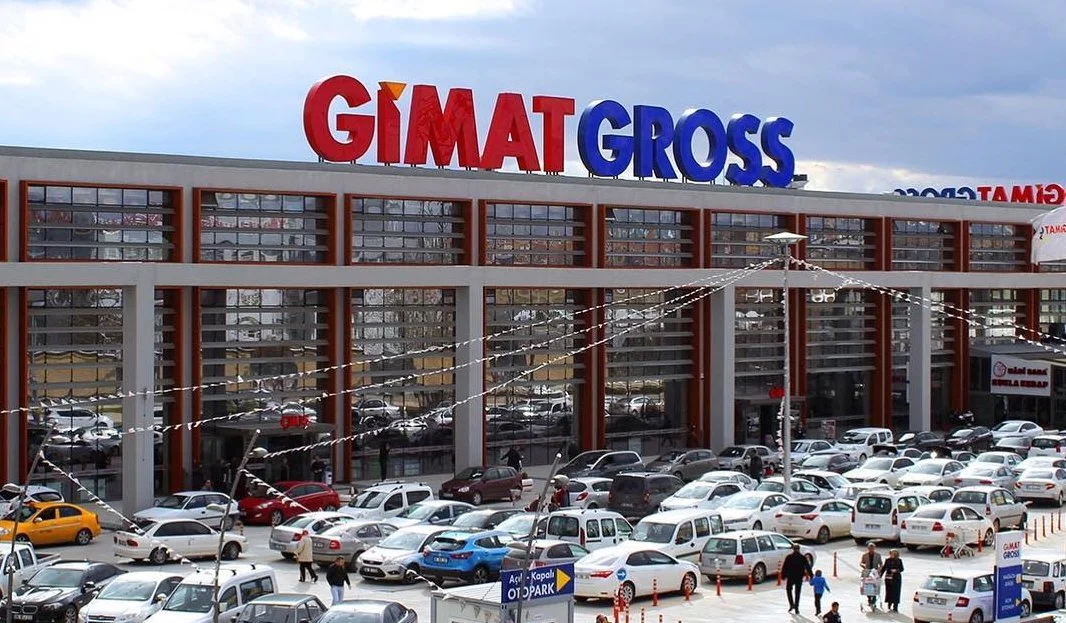
Gimat Magazacilik Sanayi ve Ticaret A.S. (GMTAS.IS)
Gimat Gross is an Ankara-based wholesaler-retailer that trades under the ticker GMTAS.IS on the Istanbul Stock Exchange. Gimat began life as a cooperative of food traders. Today it is a listed company with a growing retail footprint, a deep regional moat, and a culture that will propel them well in their next stage of growth.
To understand Gimat, you need to picture Ankara, Turkey’s capital and second-largest city, in the early 1990s. Turkey’s economy was liberalizing, the economy was growing and supply chains were highly fragmented. A thousand-plus wholesalers, most selling staples such as lentils, rice, detergent, and beverages, operated out of crowded inner-city markets. Their businesses were viable, but their infrastructure was decaying. Out of that frustration grew the Yeni Gimat Sitesi Toplu İşyeri Yapı Kooperatifi, a cooperative whose sole mission was to build a proper wholesale district.
They pooled their capital, bought land on the city’s outskirts, and constructed what became the Gimat Trade Center in Yenimahalle, a vast cluster of warehouses, stores, and logistics bays. Each member owned a unit, traded out of it, and contributed to the upkeep of shared facilities. What began as a real-estate solution became an ecosystem, a self-contained supply network for Ankara’s small retailers and restaurants.
This structure is Gimat’s original moat. The members already knew each other. They were buyers and sellers, competitors and collaborators. When the cooperative converted to a joint-stock company in 1999 and later formed Gimat Mağazacılık A.Ş. in 2015, those same networks supplied the capital, the products, and most importantly, the discipline. The business was built by people who live or die by working-capital efficiency. The business’s first 1000 shareholders were all wholesalers.
The creation of Gimat Gross in 2015 was not an act of ambition but of defense. Traditional wholesalers were observing modern retail chains such as Migros, BIM, and Sok encroaching on their traditional customer base of small retailers and restaurants. If the traders of Gimat wanted to survive, they needed to create their own consumer-facing retail channel. The first Gimat Gross Center opened soon after, built on land the company already owned. What emerged was a wholesaler and a consumer hypermarket. Like Costco, it sells in bulk and passes through low margins. Like Migros, it targets retail shoppers with modern presentation and a curated assortment. And like the original cooperative, it owns the real estate of the first store. The second store is leased and leases may be more common in the future due to capital constraints.
The Turkish regulator knocked on Gimat’s door and informed Gimat that they had too many shareholders to remain private and needed to publicly list within three years. Thus the company is a reluctant public company. The IPO was forced upon them and just before Gimat became publicly listed it had 1050 shareholders, each with approximately a 0.1% stake.
Because of those roots, Gimat’s shareholding remains unusually diffuse. Over 99 percent of shares are free float. Mohnish Pabrai’s fund, Pabrai Funds owns over 20%, Haydar Acun’s fund, Marmara Capital, owns over 5%, and at Drew Investments we own about 1%. The cooperative that once had 1,050 members has effectively become a public-market version of itself, with thousands of small holders owning a piece of the same enterprise.
At present, the company has two locations, the flagship in Ankara’s Yenimahalle district and a second location a few kilometers away. The blueprint is to open one new store roughly every two years. Each store costs about $10-20 million in capex and inventory and reaches maturity in two to three years.
If you walk through Gimat Gross today, you’ll see the cooperative DNA everywhere. Suppliers are mostly descendants of the original members. The store managers understand working capital as intimately as product mix. The culture is neither corporate nor franchised. It’s communal. That creates an unusual alignment between the operator, owners, suppliers and customers. Management’s language in the 2025 report is telling. They don’t speak about shareholder value creation but about continuity of the enterprise.
Many of the wholesalers gave their proxy to Mr. Recai Kesimal. Kesimal is a huge part of the thesis. He is currently the general manager, earning a measly salary, and holds well over 25% of the proxies on behalf of the wholesalers. In conversation with Kesimal, you won’t find an exec with perfect methodologies. You’ll find an owner with a mindset that he serves only one purpose: to serve the wholesalers and people of Ankara honestly. He is focused on reasonable expansion. He isn’t chasing mega scale. He’s careful, calculated, and focused on his purpose: serving the wholesalers who trusted him with their proxy.
More importantly, he’s a deep admirer of Costco in the United States. He visited five or so locations and commented that he had never seen people so excited and riled up at 10 am on a Saturday to get their weekly groceries and shopping completed.
Due to the IFRS 29 inflation accounting standard that was imposed on all listed Turkish businesses, the presented inflated-adjusted numbers are mostly garbage. There is not much to glean from them. I wish there was no IFRS 29 and we could make our own inflation adjustments.
The first store is 100,000 sq. ft and generates $120 million in sales. An astounding $1200/sq. ft is incredible – especially in Türkiye! Gross margins are over 20%, and PAT is over 6%. The second store is around half as big. They collectively generate about $11 million of PAT. This is worth at least $110-150 million.
Gimat Arena is a subsidiary project of Gimat Gross and consists of offices and shops currently under construction. The company is paying nothing for construction, and the developer will receive approximately half of the developed property as compensation. They will sell 162,000 sq. ft. of office space for approximately $50 million and retain the shops, which will generate approximately $1 million in annual rent. That is worth $15 million at a 6.5% cap rate.
The business is therefore worth at least $175-215 million. The market cap is about $156 million today. Gimat aspires to operate 80 stores in Türkiye, one in each province. They also want to open stores in Germany eventually. 15% of Germany’s population is of Turkish origin. If they are not able to grow, we likely do not have much of a loss. If things do work, it is a home run.
“I’ve always believed that nothing was worth an infinite price. So at some point even an admirable place like Costco could get to a price where you would say ‘that’s too high’. But I would argue that if I were investing money for some sovereign wealth fund, or some pension fund and had a 30, 40, or 50-year time horizon, I would buy Costco at the current price.”
- Charlie Munger speaking on Costco at the Feb 2022 Daily Journal AGM
Calling Gimat the Turkish Costco forces a harder question than whether the stores look similar or whether customers behave the same way. It forces the question of whether Gimat, like Costco, can generate high and sustainable returns on capital over long periods of time.
Gimat’s moat comes from ordinary but powerful sources: fast inventory turnover, payables that tend to move more slowly than inventory, and a low-margin, high-volume model that deliberately passes value to customers rather than extracting it from them. As long as Gimat has a robust growth rate, the unit economics are compelling and there will be long-term shareholder value created.
These assumptions require Gimat to execute with the same methodical patience that built the cooperative in the first place. The market sees a small, illiquid Turkish retailer. At Drew, we see a 30-year compounder entering its second act, with a brilliant, straightforward blueprint.
No Turkish business is risk-free. With 99 percent free float and no true controlling shareholder, accountability relies on board culture rather than ownership. So far, that culture has been conservative, with minimal debt, regular dividends, and cautious expansion. The board’s composition, the veteran wholesalers of the original cooperative, and Mr. Recai Kesimal all suggest a minimal risk at the moment.
The subtler risk is ambition. Gimat’s moat exists precisely because it operates within its competence. Too aggressive of a push into distant geographies or e-commerce could dilute its advantage. The key is to grow within the circle of trust that defines the brand. We would rather see five great centers than fifteen mediocre ones.
It is a business that compounds through repetition, not reinvention. Every new center reinforces the existing network. Every customer relationship extends a line that traces back to the cooperative’s founding.
To an outsider, Gimat appears to be a provincial retailer. To us, it is a structural institution, a mechanism for turning community trust into enduring cash flow. Over the next decade, if the company simply keeps building, keeps stocking, and keeps serving its region with the discipline it has shown for thirty years, we believe it can grow exponentially in market value. That won’t happen through leverage or speculation. It will happen through patience, reinvestment, and the quiet power of alignment.